Subterranean termites require continuous contact with soil moisture to survive, building sheltered mud tubes across stem walls, plumbing penetrations, and expansion joints to access wooden framing. In Central Florida…
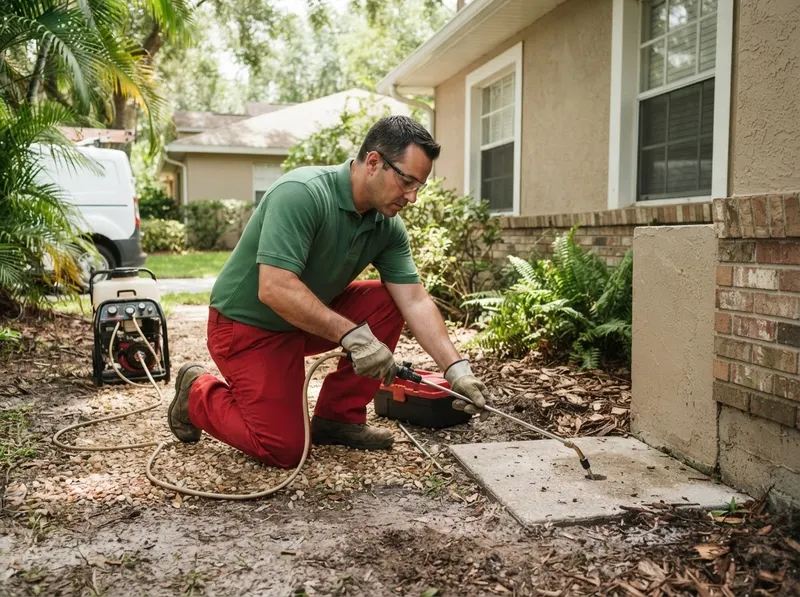
Subterranean termites require continuous contact with soil moisture to survive, building sheltered mud tubes across stem walls, plumbing penetrations, and expansion joints to access wooden framing. In Central Florida communities bordering Lake Tohopekaliga and Shingle Creek Regional Park, sandy ground and frequent water table shifts create accelerated pressure from native subterranean species (*Reticulitermes*) and aggressive Formosan subterranean colonies. In slab-on-grade subdivisions across Buenaventura Lakes, Poinciana, and Crescent Lakes, foragers enter structural framing through hairline foundation fractures measuring less than 1/32 of an inch. Older frame-over-crawlspace construction in the Kissimmee Historic District presents open soil under joists, whereas modern master-planned residences in Celebration, Bellalago, and Turnberry Reserve feature deep monolithic slabs that demand targeted liquid rod injections adjacent to exterior footers.
Selecting between a non-repellent liquid soil barrier and an exterior bait matrix depends entirely on foundation geometry, ground drainage, and landscape disturbance. A liquid soil trench creates an uninterrupted zone of non-repellent active ingredient 6 inches wide and 6 inches deep against the foundation perimeter. Foragers pass through the zone unknowingly, transferring the chemistry throughout the subterranean colony via social grooming within 30 to 90 days. The operational trade-off centers on exterior disturbance: liquid barriers require drilling through attached patio slabs, walkways, and garage thresholds, whereas bait systems preserve hardscaping by utilizing discreet subterranean cartridges spaced every 10 to 15 feet in turf. For short-term rental owners near Indian Ridge and Tapentry, installing perimeter protection halts silent structural consumption without exposing arriving vacationers to baseboard chemical smells or indoor treatment downtime.
1. Diagnostic assessment: A technician probes baseboards, scans interior drywall thresholds with thermal or acoustic tools, and inspects the exterior foundation perimeter for mud shelter tubes and swarm cast wings.
2. Trench and injection setup: For liquid applications, technicians dig a continuous 6-inch trench along exposed foundation soil and drill 1/2-inch holes through adjoining flatwork every 12 inches.
3. Material application: Termiticide binds to the soil at a standard volume of 4 gallons per 10 linear feet per foot of depth, followed by immediate backfilling and mortar-patching of all drilled injection points.
4. Verification: The perimeter is mapped with exact linear footage, subterranean soil contact zones are verified, and an annual inspection protocol is established to monitor surrounding colony activity.
Every job gets a firm, written price after a free on-site visit.
Tell us about your subterranean termite treatment job in Kissimmee and we'll send a clear, written quote, usually the same day.
 Whitetail Pest Control